
Inc. | Ed Gage’s Antiques Show Draws 100,000 People to a 90-Resident Town. His Story Holds a Lesson for Every Founder
 X
When Marburger Farm Antiques founder Ed Gage was 5 years old, someone found him digging in an alley in St. Louis. When asked what he was doing, he had a perfectly reasonable explanation: “I’m looking for treasure.”
Decades later, that same curiosity has become the foundation of Marburger Farm Antique Show in Round Top, Texas, where more than 200 dealers gather to sell everything from fine art to objects whose appeal is a little harder to explain. The scene draws more than 100,000 visitors—including celebrities like Joanna Gaines and Matthew McConaughey—to a town of roughly 90 residents. This month, Marburger is unveiling Gage Hall, a new exhibition building named for its eccentric founder.
While reading about this town (and adding it to my bucket list), I thought about how much of modern marketing is designed to remove uncertainty: we tell people exactly what they’re getting, why they should want it, and what to expect along the way. But Gage has built a business around almost the opposite proposition—the possibility of finding something you didn’t know you were looking for.And perhaps more interestingly, he’s made that uncertainty something people look forward to experiencing again and again. The objects change, the dealers bring their own personalities, and no two visits are quite the same. Yet the reason people return seems remarkably consistent.
Ahead of Marburger’s milestone event, I spoke with Gage about how he turned a childhood treasure hunt into a business and what the rest of us might learn from it.
1. Be known for a specific taste
Gage knows exactly what he’s looking for, yet sometimes the right pieces seem to find him. Around 2013, the year he got sober and began getting back on his feet, he spotted two rough 19th-century works at a store and later identified them as Charles Russell’s famous “Indian Portrait” pieces. “For me, it was the holy grail,” he says. He still owns one. Another time, a stack of papers bought from an antiques dealer friend once turned up an original 1828 Andrew Jackson letter, which he later sold on eBay.
“My core value has always been that an object should carry intrinsic value,” he says. “I most like to look for fine art, mistaken-identity pieces, and folk art that’s made with good intention.” His advice to collectors is just as direct: “Buy what you love, and buy what you’re attracted to.” And because he’s clear about what he loves, so are the people around him.
Twenty years ago, during a slow, hot show in Round Top, a friend waved him over: “Ed, come here. You like weird stuff.” Inside a four-foot-tall cast-iron water heater enclosure from England was a bronze casting of a mummified squirrel. It was a burial vault, with a dead squirrel inside. It cost $400. Today, he believes it’s on the market in France for $20,000.
A clear point of view does more than guide your own decisions. It helps other people recognize what’s right for you, too. Gage found the squirrel because a friend knew his taste well enough to flag it. Be specific enough about what you’re looking for, and other people start looking on your behalf.
2. Don’t explain the whole experience in advance
Most brands try to answer every question before a customer arrives. Gage leaves the best part unanswered. “Marburger is a destination where the mystery is actually the best part,” he says. Visitors come “to meet old friends and new friends, see over 200 dealers, and find your own treasures.”
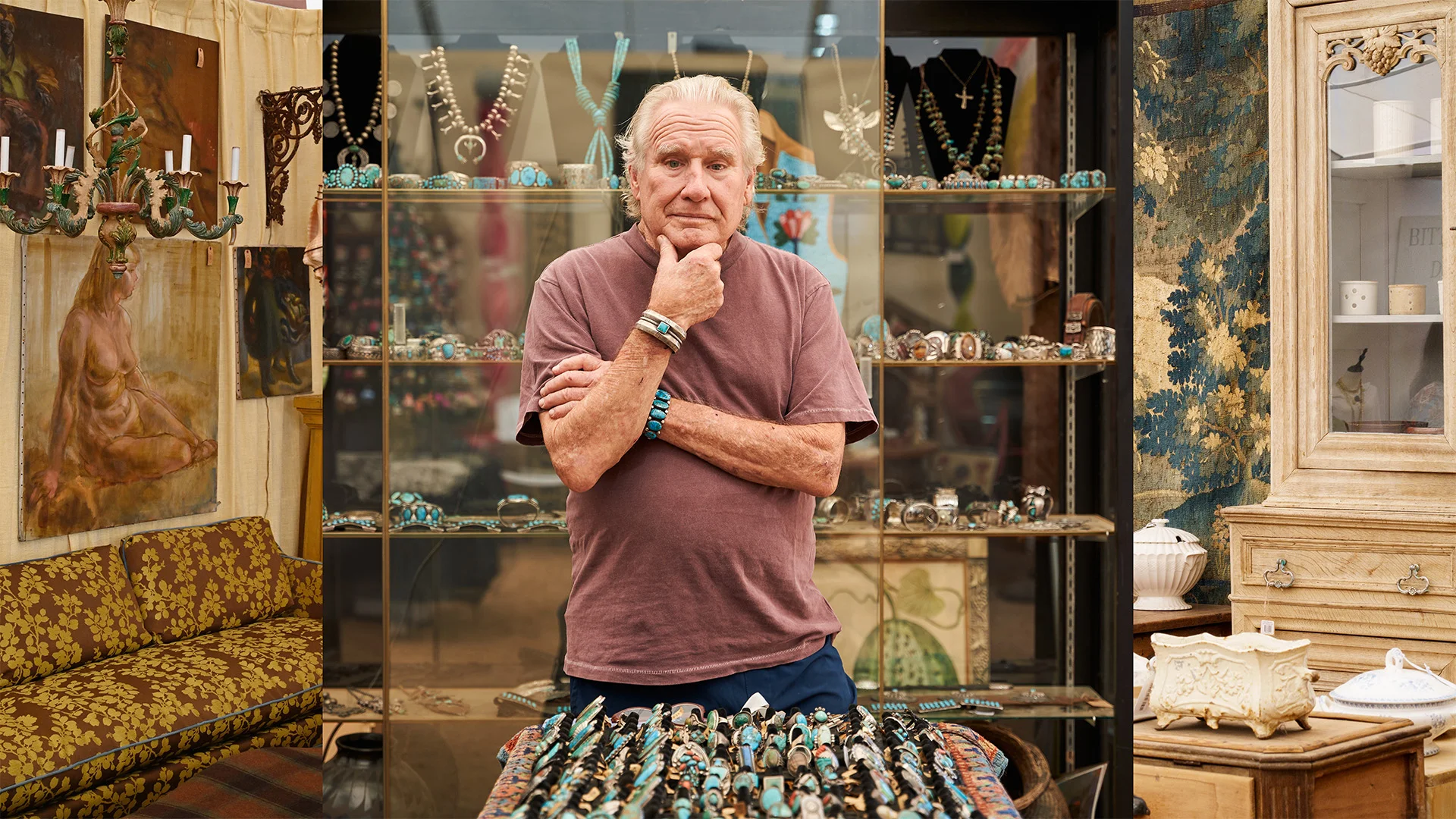
That last phrase matters. There’s a particular satisfaction in finding something for yourself, especially when you didn’t know you wanted it in the first place. A good piece, Gage says, “makes you feel like you’re the first to see it. Like it’s been waiting for someone to put it down so you could snag it.” He sees that happen at his own booth: “They’ll stop, and they didn’t even know they were looking for jewelry, when they stumble upon my showcases.”
And because no two visits turn up the same finds, the not knowing is exactly what brings visitors back. Even after days of scouring the property, Gage says, “we’re all worn out, but we get excited to come back to do it all over again.”
3. When it stops being fun, build something new
Gage’s career started on a hunch. In his early 20s, while he was loading quilts and costume jewelry from country auctions onto a flatbed truck, a friend told him he should go to Canton, Texas. “I didn’t know what that was, but I went anyway,” he says. He drove 400 miles, slept on the back of the flatbed, and woke up knowing, “I found what I’m supposed to be doing.”
By 1983, he was the first of three dealers selling antiques in front of the grocery store in Round Top. The market grew, and eventually “that show got pretty crowded and just wasn’t as fun as the market had been for me before.” Rather than accept it, he jumped the fence at the Marburger farmhouse, a building he’d long admired from the road. “I had no idea about the acreage or what went with it or anything,” he says. He thought he might rent it. He bought it a month and a half later.
Growth can quietly change the very experience that made something special. For Gage, the problem wasn’t the crowds so much as what they did to the fun of being there. Nearly 30 years later, the one thing he’s deliberately protected is the feeling he went looking for: “The whole premise of the place is still to have fun. Come browse, discover, and just enjoy it.”
4. Build the place your partners save their best work for
Marburger’s inventory comes from independent dealers, and Gage gives them room to be themselves. “Each booth is totally different and reflects the dealer. It’s done with so much intention,” he says. The result is a reputation among the people supplying the show, not just the people shopping it. “They say, ‘This will sell at Marburger,’ when they know something is really good. They save their best stuff for it.”
Any business that depends on vendors, collaborators, or a team can ask the same question: Are people bringing you their best work, or their leftovers? At Marburger, the answer has a lot to do with relationships. “People will go wherever they can find friendly faces,” Gage says. “It’s kind of like going to visit your clan again. You pick up right where you left off.”
5. Let go of what you love
For someone who has spent decades collecting, Gage is unsentimental about selling. Asked if he regrets parting with anything, he says, “Well, nothing really. If you fight it or stay upset about it, you’re stuck. But if you move on—you found an object that somebody loved before you, and you got to relive that, and now you let someone else love it too.”
He sees the payoff in the customer’s reaction. “You light up someone else’s eyes. They grab it, take off, and they’re going to be your return customer because they know they got something good.” And when you let something go, he adds, “something else comes back to you.”
There’s a lesson here for anyone building a business, pursuing an idea, or holding on to something that’s run its course: sometimes letting go is what makes room for the next discovery. Decades after that afternoon in a St. Louis alley, Gage is still looking for treasure. Only now, he’s built a place where thousands of others can look for it, too—and keep coming back, never quite knowing what they’ll find.
 Read the full article here.